UCF Leads $3M Charge into a New Quantum Frontier
NSF–AFRL REFLEQTS project pioneers time-engineered materials to unlock the next quantum revolution in computing, sensing, and communication.
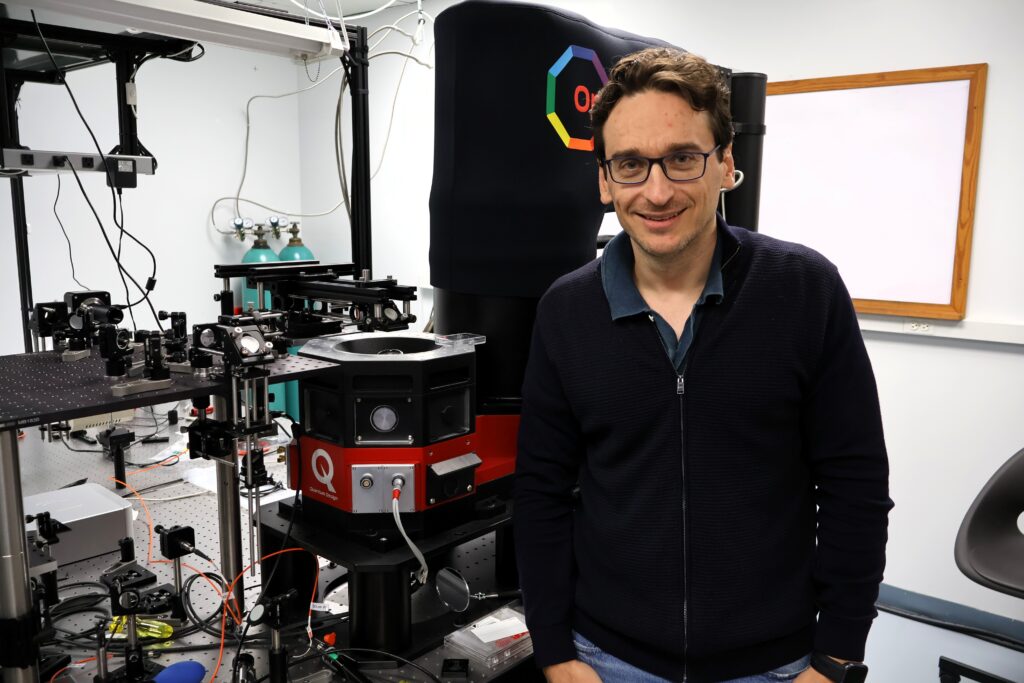
The University of Central Florida is leading a groundbreaking $3 million initiative to engineer an entirely new class of quantum devices built from materials that don’t just exist in space—but evolve in time.
Led by CREOL Professor Alex Khanikaev, the NSF-AFRL REFLEQTS project aims to “disruptively advance” quantum science, unleashing the potential for the next generation of quantum sensing, and could be transformative for quantum networks and computing. The vision: quantum-powered devices for the consumer market, which could enable the internet of the future and unlock advanced sensing capabilities.
The three-year program is backed by both the National Science Foundation (NSF) and Air Force Research Laboratory (AFRL). At large, it will advance the objectives of the NSF, AFRL, and the defense enterprise through scientific and technological efforts that possess dual applicability in numerous emerging areas of research. The grant can also be extended by two more years, making it potentially a $5 million research project. UCF is collaborating with a team of world-class researchers at the University of Rochester, University of Pennsylvania, and the City University of New York. In addition to research activities including design, modeling, and experiments, the funding will also support materials and staffing as the project moves forward.
“This is a combination of really exciting new science and emergent applications,” Khanikaev says. “It will allow CREOL to strengthen our position as leaders in quantum photonics and quantum optical sciences in Florida, and it will be a tremendous addition to the ongoing efforts and investments made by UCF in quantum in recent years”
The REFLEQTS project is an addition to a portfolio of quantum projects at CREOL. Led by Professor Andrea Blanco-Redondo, the initiative includes about 10 faculty in a joint effort aimed at expanding CREOL’s quantum research program, providing educational opportunities in Quantum Information Science and Engineering (QISE), and attracting center-scale federal funding and industrial partners. Khanikaev and Blanco-Redondo are already running a $5 million collaborative project in QISE funded by NSF, in addition to other externally funded research and education programs.
For REFLEQTS, the key lies in the science behind Floquet theory, which concerns systems that are periodically modulated – in other words, change over time. Harnessing that framework can expel the limitations of static materials, giving researchers four-dimensional control over single photons, which allows them to generate new quantum states.
“A completely new physics emerges once you engage the time dimension,” Khanikaev says. “This is the new giant leap in the ongoing quantum revolution by itself.”
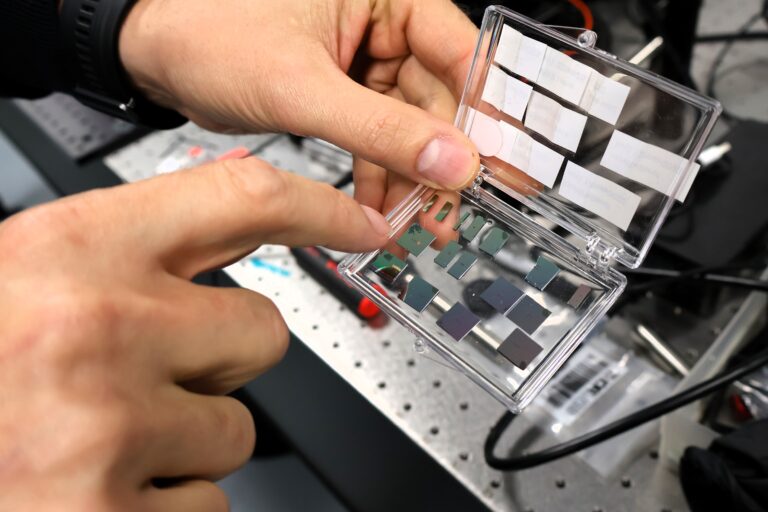
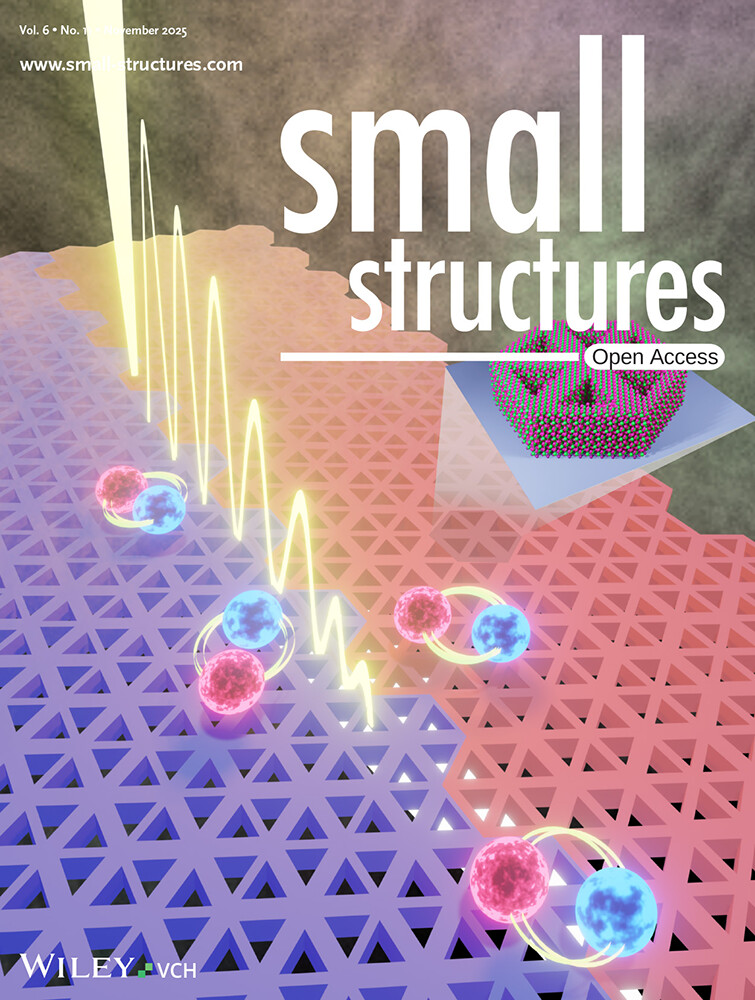
Samples of quantum photonic chips and metasurfaces to be tested in time-driven settings as in Khanikaev’s hands (left) and featured on the cover of journal Small Structures (right) [Guddala, et al, Small Struct. 6, 70142, (2025). https://doi.org/10.1002/sstr.70142].
THE QUANTUM ADVANTAGE
To put the advantages of quantum computing into perspective, Khanikaev first points to the fastest high-speed web experience on the consumer market: fiber optic internet.
“Everybody wants to upgrade to the fiber internet,” he says. “It’s faster and more reliable. Bandwidth is significantly higher.”
That bandwidth is achieved by transferring information in pulses of photons, which travel through fiber optic cables at the speed of light. The vast majority of the world’s internet traffic is carried by these cables that connect continents by running on the ocean floor. It’s a fast system – but not one that will work for the quantum computers of the future.
“For these platforms to talk to one another, light is the most efficient way,” Khanikaev says, “But let’s say I want to build a quantum computer network. The problem is, you cannot communicate quantum information with classical light, and this is where time-driven systems Floquet open new opportunities to generate and manipulate complex quantum states of light.”
In classical computers (like the smartphone you may be reading this on), the device’s power is proportional to the number of transistors it has. In quantum, however, the growth in processing power is exponential, rapidly scaling with the increase of quantum bits, or qubits. But connecting quantum devices with a traditional network would be like connecting two high-powered gaming PCs over dial-up internet.
“You will lose all your quantum advantage once a classical system interacts with the quantum state,” Khanikaev says.
Therefore, quantum computers need a quantum network, which means rather than sending “packets” of light through fiber optic cables, they need to trade individual photons or multiple photons entangled with one another. An added benefit is increased security: this allows for quantum key distribution, which would immediately alert the user if they’re being observed. With a proper network, the “quantum advantage” would be realized not just over the internet, but also in the broader telecommunications industry.
“Quantum communications and quantum computing will benefit tremendously from the opportunity to generate and control quantum states of light, but so will sensing, because the quantum states can be engineered to be highly sensitive beyond the limits of classical optical sensors,” Khanikaev says.
BUILDING THE DEVICES OF THE FUTURE
Quantum devices in use today, such as superconducting quantum circuits, must operate in particular environments – which can make them expensive.
Efficient sensors used to detect single photons for telecommunications applications need to operate at cryogenic temperatures, which requires tremendous amounts of energy and space. These limitations restrict the operation and ownership of these devices to entities with expansive financial and industrial resources.
Khanikaev and his collaborators aim to design a new class of single-photon detection devices that not only deliver superior performance – but are also lightweight, portable, affordable, and can operate at higher temperatures than their cryogenic counterparts.
“Our goal is to make these devices more practical and deployable,” Khanikaev says, “Because you cannot have cryo-cooled, bulky systems all over the place.”
This framework would enable the possibility of quantum-powered devices on the consumer market. Lightweight single-photon detectors also have the potential to greatly improve sensing capabilities on aircraft and satellites.
SOMEWHERE IN TIME
What will make that possible is the time-based manipulation of photons, which researchers accomplish using laser pulses. To explain Floquet theory, Khanikaev points to his computer mouse:
“If I click this button, something will happen, right? Essentially, this is feedback. It’s the same in materials. Send a laser pulse, and it will transiently modify the material. By controlling the intensity of laser light which is turned on and off very rapidly and periodically, we can make materials transparent or opaque. It can be a really small variation in the refractive index– you wouldn’t even see the difference if the change is uniform– but on the nanoscale and when applied both in space and time it will make a difference. In this way, you can dynamically control the material by essentially drastically altering its properties .”
The team can now modulate materials in this way, to create photons entangled in a very specific and controllable way.
“Floquet modulation allows us to generate even more interesting quantum states of light,” Khanikaev says, “And because it’s a dynamic modulation, we can control structure of these quantum states of light. Moreover, we could not only engineer, but also reprogram them.”
That reprogrammability can potentially enable the generation of quantum states of light for both the processing and communicating of quantum information.
“In the end, this is what all this quantum hype is about, because it can bring new technologies,” Khanikaev says.

ABOUT THE RESEARCHER
Khanikaev received his PhD degree in Physics from the M. V. Lomonosov Moscow State University in 2003. After graduation, Dr. Khanikaev spent five years at Toyohashi University of Technology, Japan, followed by a stint as a research associate at the University of Texas at Austin, where he contributed to the fields of infrared photonics, plasmonics, all-dielectric metamaterials, biosensing, and 2D materials. In 2012, Khanikaev introduced the concept of photonic topological insulators. In 2015 he pioneered the field of topological acoustics. In 2013, Khanikaev joined the City University of New York as a faculty member. Since 2024, Khanikaev has been an Endowed Professor, Cobb Family Eminent Scholar Chair, at CREOL. He is a Fellow of Optica, Senior Member of SPIE, a recipient of the NSF Special Creativity Award (2021), and Clarivate Highly Cited Researcher (2022-2024). Khanikaev’s current research focus is on theory, design, and experimental studies of photonic nanostructures, quantum and low-dimensional materials for photonics applications.