Summer Research Experience at CREOL Changes How Student Sees Science
A 10-week internship supported by Grinnell College gave an undergraduate researcher the opportunity to explore photonics and a new way of thinking about research.
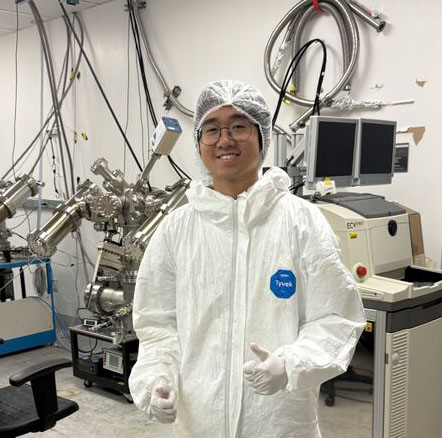
When Thang “Timmy” Ly arrived at CREOL, The College of Optics and Photonics this summer, he had never designed an optical instrument, used computer-aided design software or stepped inside a machine shop.
Ten weeks later, he had built an optical metrology instrument from scratch, designed a nanophotonic metasurface and learned a lesson that would shape how he approaches research in the future: exciting results matter only if you can prove they are right.
The experience was made possible through a connection between CREOL Assistant Professor Leland Nordin and his undergraduate alma mater, Grinnell College. Nordin earned his bachelor’s degree in physics from Grinnell before pursuing graduate degrees in electrical and computer engineering and eventually joining UCF.
For the past three summers, Nordin has hosted Grinnell students at CREOL, with Grinnell providing funding to support their summer research experiences. Since Grinnell is a small liberal arts college, students have fewer opportunities to participate in the kind of specialized research available at a major research institution like UCF.
For Nordin, the arrangement is a win-win. It gives Grinnell students access to hands-on research opportunities in optics and photonics while introducing talented undergraduates to CREOL and the possibilities of pursuing graduate research at UCF. The connection has already extended beyond the summer program; a Grinnell graduate is currently a member of Nordin’s research group at CREOL.
This summer, Timmy joined Nordin’s Advanced Photonic Devices Lab, where he worked on projects spanning semiconductor metrology and nanophotonic design.
On the experimental side, he built a dark-field optical metrology system designed to characterize semiconductor wafer surfaces. The project took him through nearly every stage of developing an instrument — from working out the optical geometry and learning CAD to machining parts and developing software to collect and analyze data.
He also explored computational design, creating a nanophotonic metasurface intended to enhance nonlinear quantum light generation.
But some of the most lasting lessons came not from what he built, but from learning how to question his own work.
About two-thirds of the way through the internship, Nordin asked him a deceptively simple question: How can you verify your simulation approach?
The question changed the way Timmy thought about research.
Reflecting on the experience, he said he learned to distrust his own numbers until they could withstand scrutiny. He kept a running record of predictions that turned out to be wrong — 11 in all — using each one as an opportunity to diagnose what happened and reconsider conclusions that could no longer be defended.
By the end of the summer, his definition of successful research had shifted. It wasn’t simply about producing an impressive result. It was about producing one that could be tested, benchmarked and defended.
For Timmy Ly, the experience at CREOL is already influencing what comes next. This fall, he will begin studying electrical engineering at Columbia University, taking with him not only new technical skills, but a different understanding of what it means to conduct research.
As he reflected at the end of his internship, the biggest lesson of the summer wasn’t technical at all. Research, he discovered, isn’t simply about finding an answer, it’s about making sure that answer can stand up to being questioned.