New Professor Brings High-Powered Industry Experience to CREOL
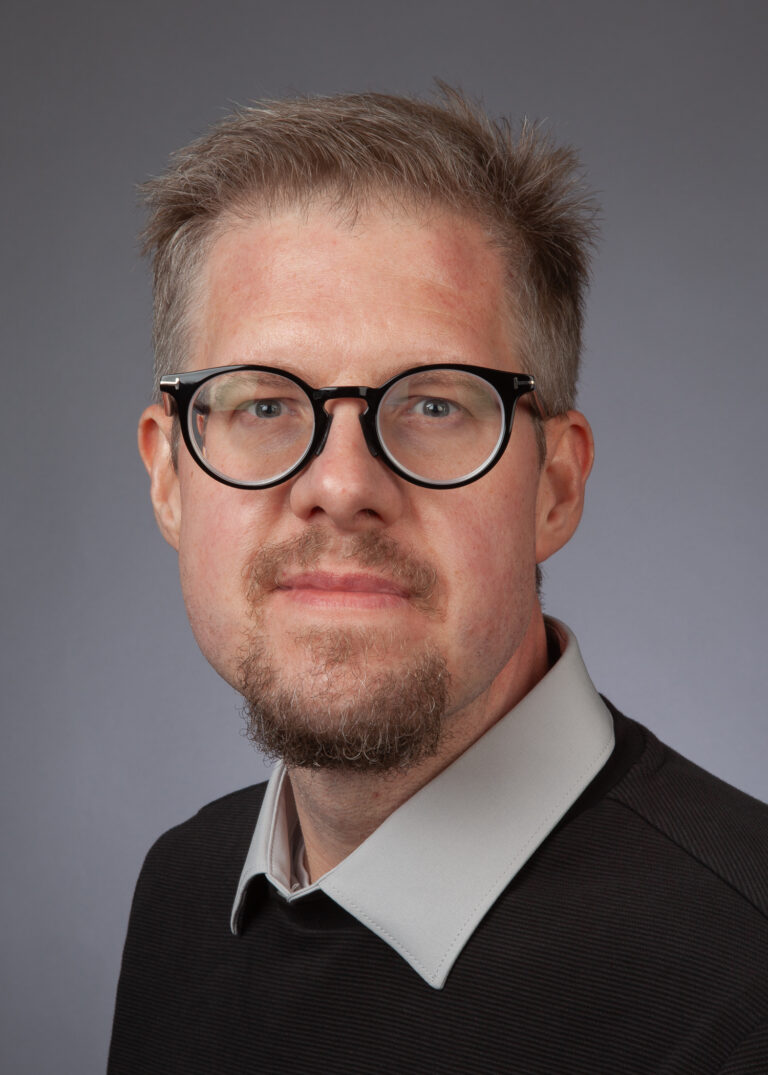
Paul Leisher’s path to UCF spans continents, academic disciplines, national laboratories, startups, and industry giants.
“It just seemed natural to end up here,” Leisher says.
With more than 15 years of industry experience and nearly 6 years in academia, he comes to CREOL as the newest Professor of Optics and Photonics. Between teaching Senior Design I and continuing his research on high power semiconductor diode lasers, Leisher will leverage knowledge from a career that has been unified by a deep belief that teaching and research are inseparable.
Leisher brings a resume full of research breakthroughs and innovative laser engineering, having held high-level positions at Lawrence Livermore National Laboratories, nLight, Freedom Photonics, and Luminar Technologies. Previously an Associate Professor at the Rose-Hulman Institute of Technology, Leisher’s passion for working with students makes him ideal to join the collaboration at CREOL.
“The number of places that have dedicated programs and strength in this area is frighteningly small,” says Leisher. “I can’t think of a single innovative area that isn’t enabled by photonics: AI data centers, advanced transportation technologies, autonomous vehicles, energy security, and space exploration – semiconductor lasers play an important role in all of these.”
HIGH TECH IN THE CORNFIELDS
Leisher was born in Brazil and grew up in northern Illinois. He attended Bradley University in Peoria as an undergraduate student pursuing an electrical engineering degree, with an interest in control systems. He recalls taking numerous 2-hour bus rides across the state to visit his wife, who was studying at the University of Illinois Urbana-Champaign. Those drop-ins to UIUC foreshadowed what would become the next step of Leisher’s academic career – after his Plan A hit a speedbump.
“During my senior year, my university’s fall career fair was the week after September 11th,” Leisher says. “I went there looking for a job, but employers at the time had so much uncertainty about what the future would hold. I wanted to enter industry, but it wasn’t clear that I would be able to.”
So Leisher took his future into his own hands: after graduating with his B.S. in 2002, he enrolled at UIUC to pursue his Ph.D., spending much of his time in the cleanroom making semiconductor devices and fostering his interest in quantum electronics and lasers. In particular, he studied VCSELs (vertical-cavity surface-emitting lasers), which are low-power devices with wide applications, from computer mice to facial recognition in smartphones.
A CAREER OF INNOVATION
After earning his doctorate in electrical engineering, Leisher shifted his focus. In January 2007, he was hired at nLight in Washington state as a device engineer, where he worked on projects that were several orders of magnitude more powerful than what he produced in college.“I went from working with diode lasers capable of delivering milliwatts to diode lasers capable of delivering kilowatts,” he says.
Leisher’s responsibilities soon expanded to include submitting grants to secure external funding for research efforts. Two of these projects were in collaboration with CREOL faculty members Professor Leonid Glebov and Professor Eric Johnson.
“This was my first introduction to CREOL as a powerhouse of optics and photonics research,” Leisher says, “Our joint efforts led to significant advancements in high power diode laser technology.”
In 2011, he joined the faculty of Rose-Hulman Institute of Technology in Terre Haute, Indiana as an Associate Professor, trading high-power lasers for a high-power workload: Leisher taught nine courses a year, including senior design, geometrical optics, lens design, semiconductor physics, laser physics, introductory physics, and multiple undergraduate lab sequences. He also got to know future CREOL Dean David Hagan, who was on the advisory board of Rose-Hulman’s optical engineering program at the time.
“He got to know me as a professor dedicated to teaching undergraduate students,” Leisher says, “And I loved that job dearly.”
After six years in Indiana, Leisher’s laser design research landed him an offer to become the chief engineer for laser diodes at Lawrence Livermore National Laboratory in Livermore, California.
“The research results were great,” Leisher says. “One key result was looking at the influence of back irradiance on diode pump laser systems.”
As Leisher explains, laser diodes that are ordinarily reliable can degrade faster when they’re integrated into systems which are pumping gain material.
“That problem really hadn’t been studied closely,” Leisher says.
Two short years later, in 2019, Leisher moved to Santa Barbara to work as the Vice President of Research at Freedom Photonics – where he immediately came face-to-face with his own work.
“My first day at Freedom Photonics, I had found out that they had sampled some tapered laser diodes to a company called Luminar,” Leisher says. “These were lasers that I had developed jointly with Freedom Photonics while I was a professor at Rose-Hulman under a NASA-funded Early-Stage Innovations grant.”
Leisher says he immediately reached out to Luminar to propose a more serious laser development project with them. In the meantime, Leisher went on to secure more than $30 million in research funding contracts for Freedom Photonics over the next few years, many focused on the same fundamental tapered laser technology that Luminar was interested in.
“We had a pretty major breakthrough which solved a longstanding brightness scaling problem,” Leisher says. He explains that tapered lasers struggle to maintain good beam quality as the injection current (and output power) are increased.
“We managed to demonstrate a particular design where the beam quality actually improved as you pumped it harder; it was completely different than anything that had been seen before.” These approaches to high power laser design were also applied to other products that Freedom Photonics was developing.
Luminar bought Freedom Photonics after going public. Now part of Luminar, Leisher’s responsibility was to deliver a high-power laser on a commercial scale.
“The goal was to take something that costs about $1,000 and try to get the price down to about $100,” Leisher says. “And by God, we did it.”
FINDING A HOME AT CREOL
Having built a long resume of industry and research successes, Leisher still reflected fondly on his time teaching – which is what ultimately led him to CREOL.
“My purpose in life is to teach,” he says, “And to do research not solely for the sake of the results, but in an environment where students are learning what it means to do good research.”
During his first semester, Leisher is teaching the undergraduate senior design sequence. His High Power Diode Laser Research Group will focus on the design, fabrication, and characterization of semiconductor lasers.
“Every graduate student who works for me will need to successfully make a diode laser in CREOL’s cleanrooms,” he says.
He hopes their results can enable new applications in things like space photonics. Leisher says he’s also excited about the potential for broad collaboration with other faculty members and with industry.
“I am genuinely excited to join a college that fosters a warm, welcoming culture and a strong sense of collegiality,” he says.
MORE ABOUT PAUL LEISHER
Paul Leisher is a leading authority on high-power semiconductor lasers with over twenty years of experience across industry, government research, and academia. He currently serves as Professor at the University of Central Florida (UCF) College of Optics and Photonics (CREOL) in Orlando, Florida and serves in a technical advisory role to the boards of several companies. Prior to joining UCF, Dr. Leisher was Vice President of Research and Fellow at Luminar Technologies, where he was responsible for leading the company’s development of laser sources for LIDAR and at Freedom Photonics where he led the development of the world’s highest brightness laser diodes. Dr. Leisher held previous positions as Chief Engineer for Diode Lasers at Lawrence Livermore National Laboratory, Associate Professor of Physics and Optical Engineering at Rose-Hulman Institute of Technology, and Manager of Advanced Technology at nLight Corporation. Dr. Leisher has worked as a consultant for numerous companies ranging from small domestic photonics startups to large multinational corporations in the automotive and industrial manufacturing fields. He received his Ph.D. in electrical and computer engineering from the University of Illinois in 2007. He has authored/co-authored over 350 technical patents, journal articles, and conference presentations. Dr. Leisher serves on the technical committee of many conferences and is an active reviewer for most journals in the field. He served as co-chair of the SPIE Components and Packaging for Laser Systems Conference for ten years, the program track chair for the SPIE LASE Symposium Nonlinear Optics and Beam Guiding conferences for five years, and the program chair and general chair of the International Semiconductor Laser Conference (ISLC) in 2022 and 2024, respectively. Dr. Leisher is a senior member of SPIE and IEEE.