Listening With Light: CREOL Researchers Use Engineered Laser Light to Detect Underwater Sound
Navy-funded research by CREOL’s Eric Johnson and Keith Miller shows how engineered laser light can detect underwater sound with a single sensor, opening new possibilities for maritime sensing.
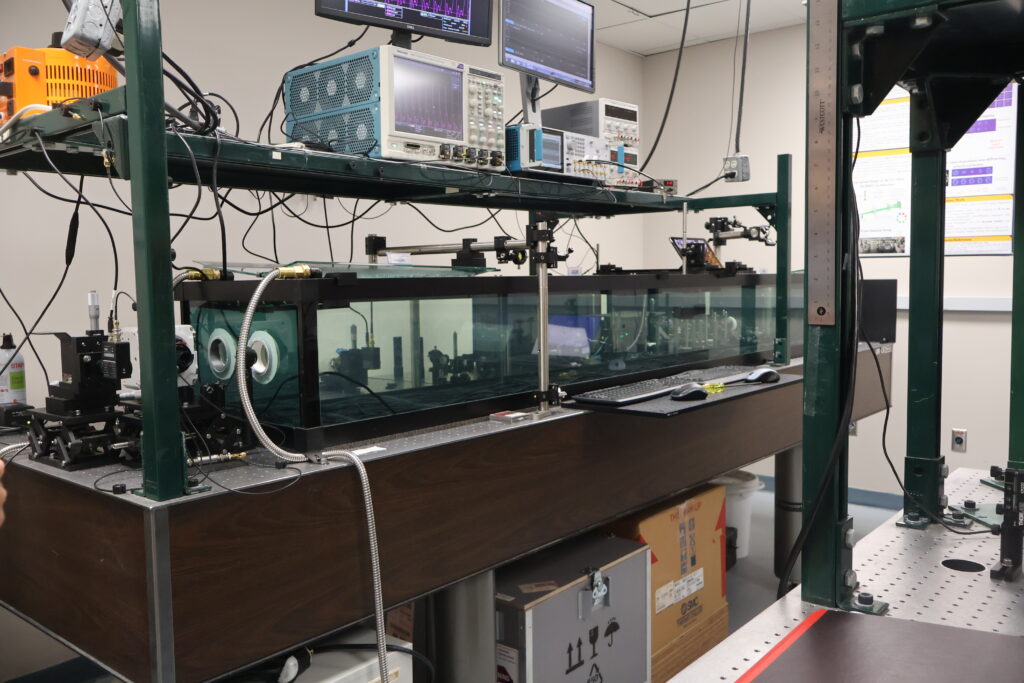
Researchers at UCF’s College of Optics and Photonics (CREOL) have demonstrated a new way to detect underwater sound, and changes in the water itself, using engineered laser light.
Supported by the U.S. Navy’s Office of Naval Research, the work uses light that responds to subtle changes in underwater environments to measure acoustic activity and ocean conditions.
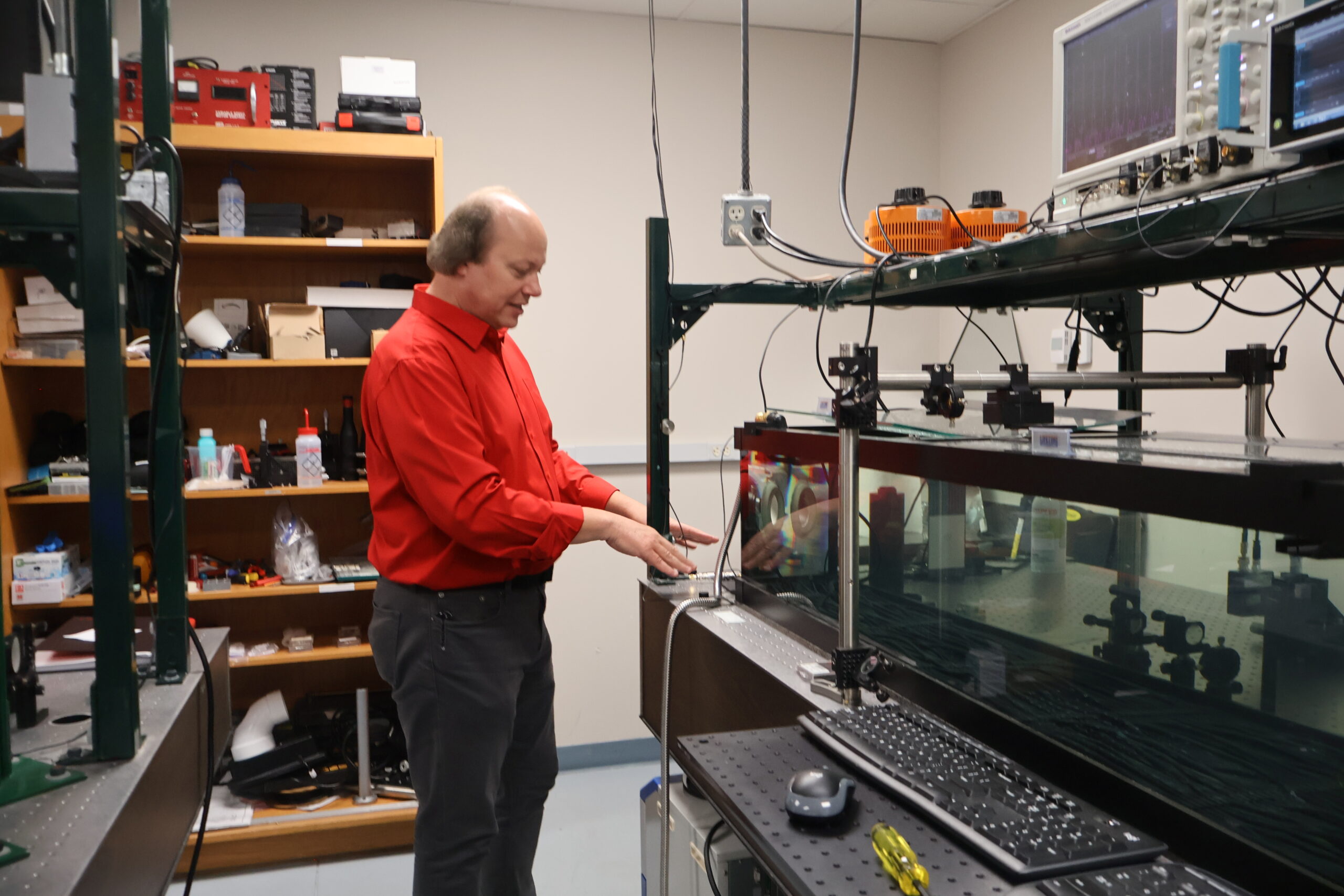
Led by CREOL Professor Eric Johnson and CREOL research scientist Dr. Keith Miller, the team reported its first results in a recent study published in Optics Express, in which the researchers detected sound traveling through a 10-foot water tank by measuring its effect on a laser beam, using just one light detector. Miller is the study’s lead author.
Detecting Underwater Sound with Light
Sound is one of the primary ways information travels underwater. While radio waves weaken rapidly in seawater, sound waves can travel considerable distances, making acoustic sensing important for oceanographic research, marine biology, maritime navigation and naval operations.
Conventional underwater sensors, such as hydrophones, measure changes in water pressure caused by sound waves. The UCF team instead detects those disturbances through their effect on a laser beam passing through the water.
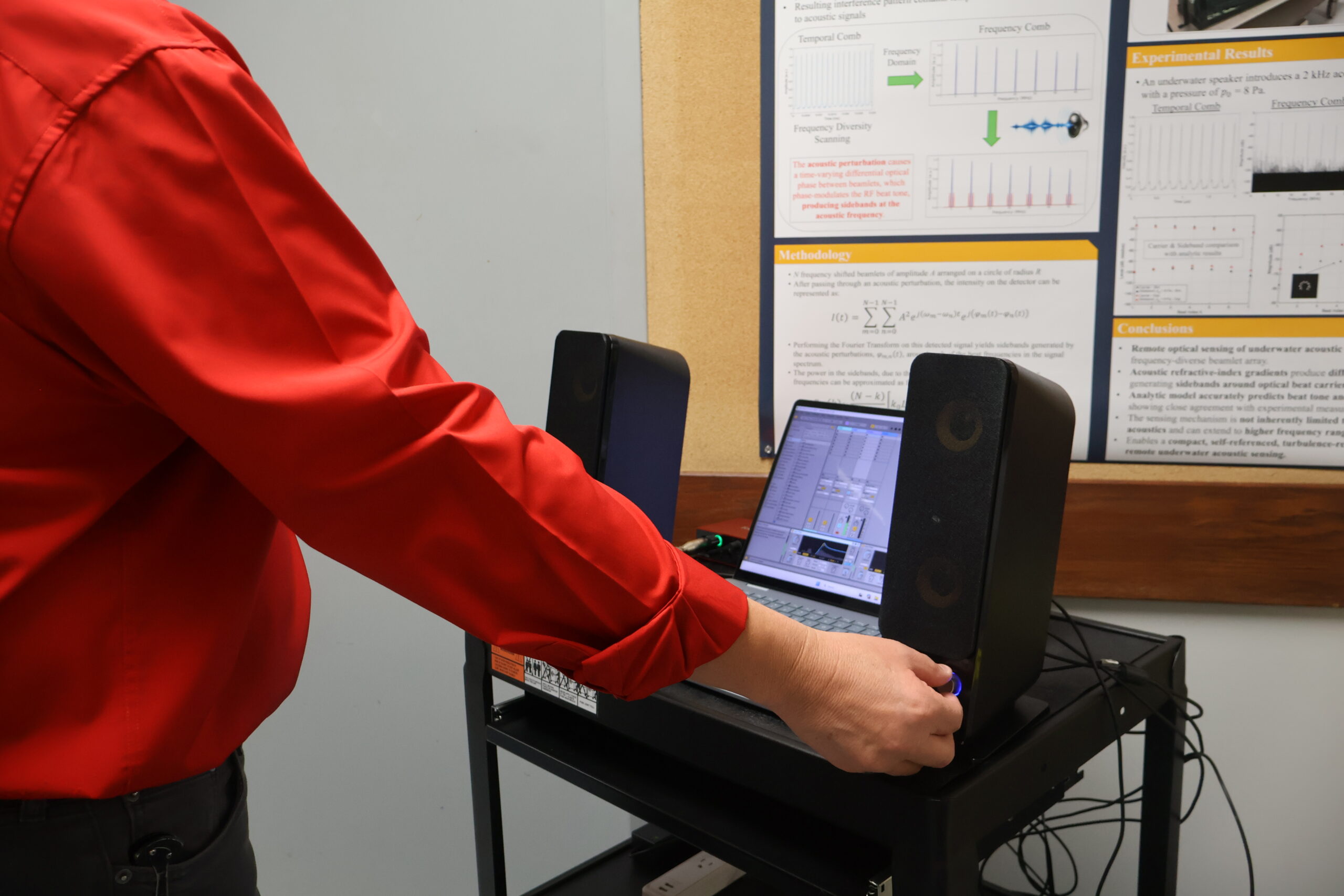
As sound travels through water, it produces small changes in the water’s refractive index, which determines how light bends as it passes through a material. By measuring how these changes affect a laser beam, the researchers can recover the sound itself.
“The exciting opportunity is to structure the light so that its interaction with the environment writes information directly into a signal we can measure,” Johnson says. “Rather than trying to reconstruct everything happening to an optical beam, we can design the illumination and detection together to reveal the physical changes we want to sense.”
Engineering Light to Measure Environmental Changes
The key is engineering the light so it reports on its surroundings. The team’s approach, called frequency-diverse structured illumination, splits a laser into an array of small beams, or beamlets, and gives each one a slightly different frequency, much like assigning each a different musical note. When the beamlets reach a single detector, every pair beats together like notes in a chord, producing a set of tones. Sound and other changes in the water shift those tones, so one detector can follow what is happening across the entire beam.
“In effect, we turn a single light detector into an entire sensor array. The light organizes the information for us, so what comes out is one simple signal that carries a surprisingly rich picture of what’s happening in the water,” Miller says. “It’s an elegant technique that applies far beyond sound, and we’re just scratching the surface of what we can measure with it.”
In the published study, Miller and colleagues combined this technique with heterodyne interferometry, which uses the interference of light waves to detect small changes in an optical signal. In the tank experiments, the system detected underwater sound in the kilohertz range, and ongoing work suggests it can reach into the megahertz range as well, all with one detector. With a single detector doing the work of many, the approach could lead to simpler, more compact sensing systems.
Exploring Applications Beyond Underwater Acoustics
While acoustic sensing is a primary focus, the technology could support other oceanographic measurements. Temperature, salinity and water movement also affect how light travels through seawater. By designing optical fields that respond to these changes, the researchers hope to develop new ways to measure underwater conditions, leading to optical sensors that complement existing oceanographic instruments.
The technique could also be used to listen to marine life. Dolphins, for example, communicate with whistles that mostly fall below about 30 kilohertz and navigate with echolocation clicks that can exceed 100 kilohertz. Since the system’s bandwidth is set by the light rather than by a physical sensor, a single detector could, in principle, capture both kinds of sound at once. Together, these capabilities could improve understanding of changing ocean environments and support maritime operations that rely on accurate underwater measurements.
Advancing Optical Sensing in Complex Environments
Underwater environments present challenges for optical sensing. Scattering, turbulence and changes in water’s optical properties can distort light and interfere with measurements. The UCF team is exploring how engineered optical fields can turn these disturbances into useful information rather than treating them solely as obstacles.
The Navy-supported research combines structured light, optical sensing and signal processing to develop new approaches to maritime sensing. The group also designs and fabricates the specialized optics that shape the light, using wafer-based manufacturing that could make such sensors practical to produce at scale. Future work will examine how the techniques perform under more realistic underwater conditions and whether they can detect a wider range of environmental changes.
This research is supported by the U.S. Navy ’s Office of Naval Research (ONR) under award N00014-26-1-2058, “Acoustic Sensing with Higher Order Bessel Beams Integrated in Time,” and was previously supported by ONR Multidisciplinary University Research Initiative (MURI) award N00014-20-1-2558, “High Photon Density Spatiotemporal (OAM+SAM) Vector Beams for Maritime Environment.”
Research publication: J. Keith Miller, Arash Shiri, Matthew F. Reid, Aristide Dogariu, and Eric G. Johnson, “Frequency-diverse structured light for optical gradient sensing using heterodyne interferometry,” Optics Express 34(11), 19921-19934 (2026). Editor’s Pick.